



The advantages of paper packaging over other materials have become a pivotal topic in the modern economy—not just due to environmental regulations, but because of the clear financial logic driving every successful brand. At a time when consumer habits are shifting drastically and the global market demands sustainability and transparency, the choice of material for your packaging can either set you apart from the competition or push you into obscurity.
While plastic, glass, and metal dominated certain sectors for decades, technological advancements in cardboard and paper processing have sparked a revolution. Today, paper packaging is not just an “eco-friendly” alternative; it is a superior engineering solution offering better protection, cheaper transport, and, most importantly, unparalleled marketing potential. In this article, we analyze why switching to cardboard is the smartest investment for your company.
The Environmental Advantage of Paper Packaging vs. Other Waste Types
The first association with paper packaging is, undoubtedly, ecology. However, this is no longer just a question of ethics; it is pure business. Research shows that modern consumers are willing to pay more for products that do not harm the planet, while actively avoiding brands that use excessive plastic.
Natural Decomposition as a Key Benefit
The fundamental advantage of paper packaging over others lies in its lifecycle. A plastic bottle or bag takes between 400 and 1,000 years to decompose, breaking down into microplastics that permanently pollute the ecosystem. In contrast, paper and cardboard are cellulose-based materials that biodegrade in nature within just a few months, leaving no toxic traces. For companies, this translates into the ability to use “100% Biodegradable” or “Eco-friendly” labels, which directly drives sales growth.
Circular Economy and Recycling
Cardboard is a recycling champion. While plastic can only be recycled a limited number of times (and often ends up as a lower-quality material), paper fibers can be reused up to seven times before losing their properties. By using packaging made from recycled materials or sustainable sources (FSC-certified), your brand becomes an active participant in forest conservation—a message highly valued by today’s consumers.
Aesthetic Advantages: Branding Without Limits
If we consider packaging as a “silent salesperson,” then cardboard is its finest suit. No other material provides as much flexibility in printing and finishing as paper.
High-Resolution Offset Printing
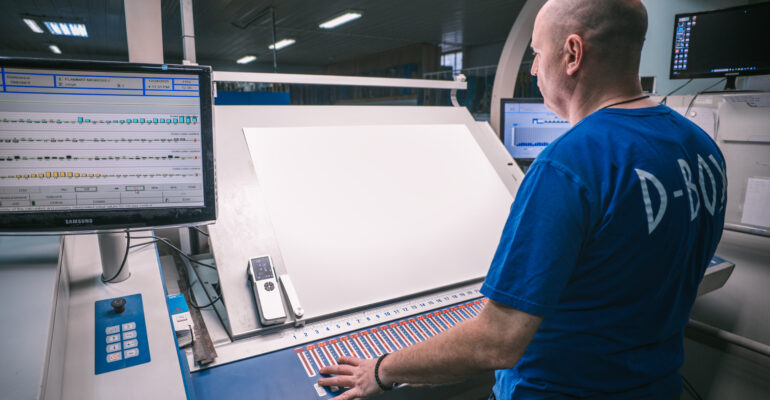
The smooth surface of duplex boards or coated papers allows for the highest quality offset printing. Unlike printing on plastic or metal, which is often technically demanding and expensive, printing on cardboard enables high-resolution photographic reproduction, perfect gradients, and absolute color precision. At D Box, we use B1 offset machines that guarantee your Pantone colors remain identical on every box, from the first to the millionth.
Luxury Finishes that Increase Perceived Value
Paper is the only material that flawlessly accepts the most demanding embellishment techniques. Do you want your product to look prestigious? Techniques such as foil stamping (gold and silver), spot UV varnishing, embossing (blind embossing), and lamination (matte, gloss, soft-touch) add a tactile dimension to your packaging. When a customer holds a box with texture and shine, their perception of the product’s value increases, allowing you to command a higher market price.
Logistical Advantages: Cost-Effective Transport and Storage
In the supply chain, every gram and every millimeter counts. Here, paper packaging wins decisively over competitors like glass, wood, or hard plastic.
How Does the Advantage Manifest in Transit?
Cardboard is exceptionally lightweight. Replacing heavy glass or metal packaging with cardboard drastically reduces your product’s gross weight. Lower weight means reduced fuel consumption for trucks, lower shipping or air freight costs, and ultimately—a lower price per unit. In an era of skyrocketing energy prices, this is a saving that directly impacts your profit margin.
Storage and the “Flat-pack” System
Perhaps the greatest logistical advantage of paper packaging over others lies in the fact that cardboard boxes are delivered and stored flat. Imagine a thousand glass jars or plastic buckets—they occupy a massive amount of warehouse space because they are filled with air. Conversely, a thousand cardboard boxes fit onto a single pallet. This frees up your valuable warehouse space for finished products and raw materials, reducing rent and handling costs.
Technical Advantage: Protection and Strength
There is a misconception that paper is “weak.” However, the modern packaging industry proves otherwise every day. Thanks to smart engineering, cardboard can be incredibly resilient.
The Power of Corrugated Board and Litho-Lamination
The secret to strength lies in the structure. Through the process of litho-lamination—where a high-quality printed sheet is bonded to corrugated board (microflute or double-wall board)—we create packaging with exceptional load-bearing capacity. The fluted structure inside the box walls acts as a series of small columns or shock absorbers that absorb impacts and vibrations during transport. Today, heavy machinery parts, sensitive electronics, and even furniture are safely packed in cardboard.
Moisture and Grease Barriers
Advancements in coating technology have allowed paper packaging to become resistant to its natural enemies—water and oil. Special coatings and varnishes (such as the dispersion varnish we use at D Box) make cardboard moisture and grease-resistant, making it ideal for the food industry, “Food-to-go” delivery, or frozen products, replacing styrofoam and plastic.
User Experience: The “Unboxing” Advantage
In the digital age, a customer’s first physical contact with your brand happens at the moment of delivery. This moment, known as the “unboxing experience,” can build or destroy brand loyalty.
Eliminating Frustration
We have all experienced the frustration of trying to open a heat-sealed plastic “blister” pack, often reaching for scissors or a knife. This is known in the industry as “wrap rage.” Paper packaging, on the other hand, is designed to be opened intuitively and easily, without tools. Smartly engineered boxes with perforations or tear-strips make opening a pleasure rather than a chore.
Warmth and Emotional Connection
Plastic and metal are cold materials. Paper is warm, natural, and pleasant to the touch. Neuromarketing research shows that consumers subconsciously associate the texture of paper with “natural,” “authentic,” and “honest” products.
Conclusion: The Clear Advantage
When summarizing all factors, the advantage of paper packaging over others is not just about ecology. It is a decision that brings financial savings through logistics, increases sales through better branding, and builds long-term consumer trust. Paper is the material that reconciles industrial needs with the needs of the planet.
Investing in high-quality cardboard packaging is not a cost; it is an investment in the image and safety of your product.
Turn These Advantages Into Profit with D Box
Now that it is clear why paper packaging is the superior choice, you need a partner with the technology and knowledge to leverage these advantages for your product.
D Box is not just a printing house; we are your solution factory. With over two decades of experience and a machine park featuring state-of-the-art B1 offset presses, lamination lines, and automatic gluers, we are ready to realize even the most demanding projects.
Whether you need:
-
Shipping packaging that protects heavy goods,
-
Luxury boxes with foil stamping for premium cosmetics,
-
Eco-packaging for food products,
Our team is here to guide you from concept and construction to the finished product in your warehouse. Do not let your premium product be wrapped in average packaging.
Contact us today for a free quote. Let us show you why D Box is synonymous with high-quality cardboard packaging.