



The dilemma between offset printing and digital printing is one of the first and most critical questions brand owners and procurement managers face when developing packaging. Choosing between these two technologies is not just a technical matter; it is a strategic decision that directly impacts your product’s price, shelf appeal, and, ultimately, your profit margin.
In a world where packaging is the consumer’s first point of contact, a wrong choice in technology can cost you—either in excessive spending (if printing high volumes digitally) or in quality (if digital cannot match your design requirements). At D Box, we address these questions daily. That is why we have created this detailed guide to clarify the differences between offset and digital printing and determine which option brings a higher Return on Investment (ROI) for your business.
Understanding the Difference: The Production Process
To make the right decision, we must first understand how these technologies work, as the processes differ drastically.
How Digital Printing Works
Digital printing operates similarly to a professional-grade office printer but on a much larger scale. Files are transferred directly from the computer to the paper using toners or liquid inks. There is no need for printing plates or complex machine setup.
This means the job starts instantly. You click “Print,” and the first box is ready in seconds. However, this convenience comes with a trade-off—the cost per sheet is higher due to expensive consumables.
How Offset Printing Works
Offset printing is the traditional industrial standard and remains the gold standard for quality. The process involves transferring the image from the computer onto aluminum plates (CtP), then from the plate to a rubber blanket, and finally onto the paper or cardboard.
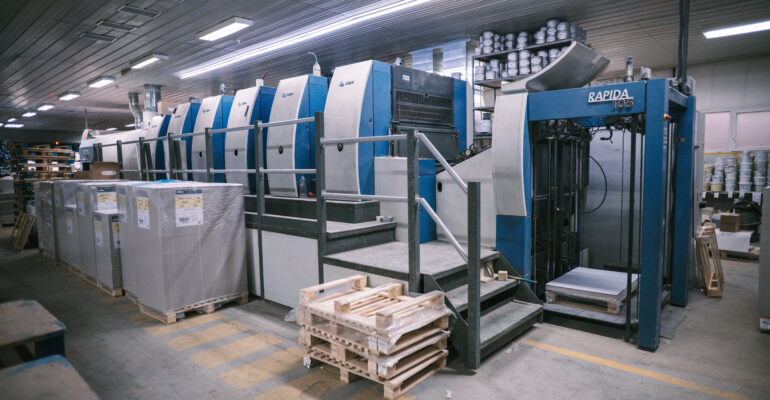
Setting up an offset press takes time and material (plate making, ink adjustment, registration). However, once a machine—such as our B1 offset presses at D Box—is running, it prints at incredible speeds (up to 15,000 sheets per hour).
When is Offset or Digital More Cost-Effective for Your Budget?
This is the turning point. The math is relentless and depends on one primary variable: Quantity (Volume).
The Economy of Offset: The King of High Volumes
In offset printing, you have a “fixed setup cost” (plates and machine preparation) that remains the same whether you print 100 or 100,000 boxes.
-
If you print 100 boxes, that fixed cost is divided by 100, making the price per unit astronomical.
-
If you print 5,000 boxes, that cost is divided by 5,000, becoming negligible.
The larger the run, the lower the unit price. For serious packaging production, offset is the only way to achieve a competitive market price.
The Economy of Digital: The Solution for Short Runs
In digital printing, the price per impression is almost fixed. The first box costs the same as the five-hundredth. There are no plate costs. Therefore, digital is cheaper for 50 promo boxes for a trade show or 100 units for market testing. However, once you cross a certain threshold (usually 300–500 sheets), digital becomes significantly more expensive than offset.
Print Quality as a Decision Factor
While digital technology has advanced, offset printing still holds the crown, especially for luxury packaging.
Color Precision and the Pantone System
Digital printing primarily uses the CMYK system. While it can simulate many shades, it often struggles to hit exact corporate colors (e.g., a specific Coca-Cola red or Milka purple).
Offset printing allows for the use of Pantone (Spot) colors. These are specially mixed inks that guarantee 100% brand consistency globally. If your branding guidelines are strict, offset is the only reliable choice.
Versatility Across Materials
Offset presses are far more flexible regarding cardboard thickness and texture. They can print on duplex board, greyboard, or even textured papers with perfect ink coverage. Digital printing sometimes fails to reach the depth of textured paper, leaving white spots, whereas offset ink is pressed perfectly into the material.
Finishing and the Luxury Look
Packaging is more than just print; it’s about varnishing, foiling, and embossing. This is where the gap between offset and digital is most visible.
Compatibility with Finishing Processes
Offset inks are more durable and better suited for post-press processes. At D Box, after offset printing, sheets move to laminating, die-cutting, foil stamping, or UV varnishing.
-
Offset: Perfectly accepts all types of varnishes (dispersion, UV) and foils. Dispersion varnish (an offset standard) protects the box from scratching and cracking at the folds.
-
Digital: Toners and digital inks often contain oils or waxes that can “reject” glue or foil. This can lead to foil peeling or boxes ungluing over time.
For clients seeking a premium look with gold foil or spot UV, offset printing provides the stable foundation necessary for these effects.
Speed and Flexibility: Meeting Deadlines
Time is money, and the perception of speed depends on the job size.
-
When is Digital Faster? If you need 50 boxes “by tomorrow,” digital wins. No drying time, no plates.
-
When is Offset Faster? If you need 10,000 boxes, offset is the champion. While setup takes an hour, a modern B1 machine finishes the run in under an hour. A digital machine would take days to complete the same order.
The Final Verdict: Which One for Your Project?
Choose Digital Printing if:
-
You need fewer than 300–500 boxes.
-
You are creating a mockup (sample) to see the box in person.
-
You have an urgent deadline for a small quantity.
-
Every box needs to be different (variable data/personalization).
Choose Offset Printing (The D Box Solution) if:
-
You are planning commercial production (500 to 50,000+ units).
-
You want the lowest possible unit price to maximize profit.
-
You require specific Pantone colors and perfect branding.
-
You plan on premium finishing (foil stamping, UV varnish, laminating).
-
You want packaging that looks professional and high-end.
Conclusion: Offset is the Foundation of Serious Business
While digital printing has its place for prototypes, when it comes to serious packaging production, offset remains unrivaled. It is the leader in quality, high-volume speed, and, most importantly, cost-effectiveness.
Your packaging is an investment. By using offset technology, you receive a product that looks more expensive than it cost to produce, giving your brand a competitive edge on the shelf.
D Box – Your Partner for Premium Offset Printing
At D Box, we specialize in industrial-scale packaging. Our facility is equipped with modern B1 offset presses that allow us to execute the most demanding projects. We do not compromise on quality. From perfectly printed sheets to precision laminating and final gluing—we control every step of the process.
Need high volumes at the best price? Contact us today and discover how D Box offset printing can elevate your business.